
21ST TRANSPORT SQUADRON,
LATER 21ST TROOP CARRIER SQUADRON,
374TH TROOP CARRIER GROUP
IN AUSTRALIA DURING WWII
History Summary of 21st Troop Carrier Squadron
| DATE | DETAILS |
| Early Jan 1942 | early Transport activities in Australia using 2 B-18s, 1 C-39, & 5 C-53s |
| 28 Jan 1942 | Air Transport Command (ATC) activated at Amberley |
| 4 Feb 1942 | Air Transport Command Headquarters moved from Amberley to Archerfield |
| 3 Apr 1942 | ATC at Archerfield redesignated 21st Transport Squadron and assigned to ATC Headquarters, Melbourne |
| 26 Jul 1942 | Redesignated as 21st Troop Carrier Squadron at Archerfield |
| 18 Feb 1943 | Relocated to Jackson Field, New Guinea |
| 28 Sep 1943 | Relocated to Archerfield |
| 26 Aug 1944 | Relocated to Nadzab, New Guinea |
Air Transport activities in the Southwest Pacific Area SWPA had their inception in early January of 1942 when 10 officers and 15 enlisted men of the 7th Bomb Group and 35th Pursuit Group began, under verbal orders, to fly cargo in two old B-18s, an old C-39 from the Philippines, and five new Douglas C-53s which were "found" aboard a ship in the Pensacola Convoy which had started for the Philippines but which docked at Brisbane, Australia under changed orders on 22 December, 1941. These first transport pilots received their transport transition training under A.N.A. airlines pilots during January 1942.
The forerunner of the 21st Troop Carrier Squadron (of the 374th Troop Carrier Group), designated as the Air Transport Command, was activated on 28 January, 1942, at Amberley Airfield, by authority of Letter, Office of the Air Officer, Base Section No. 3, dated 28 January, 1942. This letter named 1st Lieutenant Edgar W. Hampton as Commanding Officer, and ordered that "all United States transport airplanes flyable but unfit for combat will be part of the Air Transport Command.”
Upon activation the organization had 14 officers and 19 enlisted men, all assigned under verbal orders of the Commanding Officer, Base Section #3. None of the officers were trained to fly transport type aircraft, and 75 percent of the enlisted men were trained as air crew members.
An early significant mission for the new unit was when P-40 Warhawk mechanics and equipment were flown to bases in Java.
On 4 February 1942, Air Transport Command headquarters was moved from Amberley Airfield to Archerfield Airfield, in Brisbane, and Captain Paul I. Gunn, former Manager of Operations of the Philippines Airlines, was placed in command. A complement of 10 officers and 10 enlisted men all thoroughly trained in transport flying and operations, joined the organization on 8 February 1942. Among these early arrivals were M/Sgt. Kellett (who became line chief in October 1943), Sgts Rensberger, Daddario, Safranek, Gibbons and other non-commissioned officers who were the mainstays of the squadron during the succeeding 30 months. The officers were 1st Lt. Fred M. Adams, (who held the posts of Adjutant, Squadron Commander and Group Commander in succession). 1st Lt. Edward T. Imparato (Engineering Officer and later Group Commander), 2nd Lts. Haer, Cederholm (killed in the USA after his return from foreign duty), Yuska and Gerling. 2nd Lts. Grimes, Eckberg (later Squadron Commanders), and Penn (who became C.O. of the 22nd Squadron) worked at Eagle Farm Airfield assembling aircraft (A-20s and O-47s) on detached service from Air Transport Command.
In late February 1942, when the Netherlands East Indies was falling to the Japanese, Troop Carrier aircraft participated in the evacuation of military and civilian personnel. Also during February 1942, civilians serving in the Broome – Wyndham area of Western Australia were evacuated to Perth, some 900 miles south of Broome. These missions were an estimated 90% of all 374th Troop Carrier Group missions during WWII.
At Archerfield personnel were quartered in barracks and at first were sharing a mess with an Australian unit, possibly 23 Squadron RAAF. During May 1942, cooks were assigned to the organisation, and a mess hall was set up. Food was satisfactory and for recreation, the men had a day room set up in one of the barracks, equipped with a piano, radio and reading material.
During the latter part of January and early part of February 1942, P-40 mechanics and equipment were flown to bases in Java by Air Transport Command aircraft. Late in February, when the Netherlands east Indies was falling before the onslaught of superior Japanese forces, Air Transport Command aircraft participated in the evacuation of of military and civilian personnel. Also during February 1942, the Broome-Wyndham area in Western Australia was evacuated by A.T.C. aircraft which flew evacuees to Perth in Western Australia, and to Brisbane in Queensland. Two C-53s were lost during this hectic period, during which the pilots had to fly in all kinds of bad weather without adequate maps. One C-53, returning from Java found Darwin to be zero-zero and was forced to land on an emergency airfield for light aircraft on Bathurst Island, 60 miles north of Darwin. Landing in a crosswind, the aircraft damaged its left wing tip and aileron. The aircraft was destroyed by Japanese Zeros before repairs could be effected. The second C-53 was lost and made a crash landing near Wyndham after running out of fuel. It was enroute from Perth to Broome. Personnel escaped safely and were picked up two days later by an Australian flying boat.
The function of the Director of Air Transport was handled by A-3, 5th Air Force, during this early period, per verbal orders of the Commanding General, USAFIA. They were relieved of this duty in March 1942 by Lieutenant Colonel Erickson S. Nichols. Group Captain Harold Gatty, of Post and Gatty fame, became Director of the Directorate of Allied Air Transport, and Lt. Colonel Nichols became Commanding Officer of the Air Transport Command.
Between January and July 1942, the Air Transport Command flew more than 5,000,000 miles in rushing equipment and supplies to strategic points on the Southwest Pacific front. During the period 10 March to 22 March 1942, A.T.C. aircraft transported the entire 102nd Coast Artillery ( Anti-aircraft) Battalion (US) with complete equipment from Brisbane to Batchelor Airfield south of Darwin, in the Northern Territory, a distance of 1,800 miles.
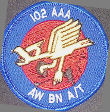
102nd Coast Artillery (Anti-aircraft) Battalion patch
The Battalion was moved in small balanced units with guns and ammunition ready for instant action. This battery, set up in the previously unprotected Darwin area, provided a very effective surprise for Japanese aircraft in subsequent raids. Wounded and evacuated personnel were flown to Brisbane on return flights. There were a number of trips to Port Moresby during that period with 30 caliber ammo for fighter aircraft being the principal items carried. These trips were made in the evening so the aircraft could leave before dawn and avoid being strafed in daylights raids. Wounded and evacuated personnel were flown to Brisbane on return flights.
For more than two months after it was activated, the Air Transport Command had only eight enlisted personnel available for maintenance. Working on a 24 hour basis, however, each man putting in an average of 17 and 18 hours a day, all six available aircraft were kept flying. During March 1942, one aircraft, a C-53, #41-20070 flew a record total of 272 hours, carrying more than 300 tons of supplies a distance of 2,000 miles.
Late in March 1942, aircraft of the Netherlands East Indies Airlines, K.N.I.L.M., joined the USAAF unit on a contract basis. They comprised three L-14s, eight Lockheed C-56s, three Douglas DC-5s, two Douglas DC-3s and two Douglas DC-2s.
These aircraft were purchased from K.N.I.L.M., and were turned over to Air Transport Command, which had expanded considerably in pilot officers and enlisted strength by assignment from casual units. Many of these officers and men were “drafted” into the organisation by Captain Paul I. Gunn (the Commanding Officer) and Captain Fred M. Adams (the Adjutant) when investigations showed the units these men belonged to were in Java and P.I. Later orders were written by USAFIA (United States Army Forces in Australia) transferring the personnel into the Squadron.
Air Transport Command at Archerfield Airfield, was redesignated as the 21st Transport Squadron and assigned to Headquarters, Air Transport Command, Melbourne, on 3 April 1942. Ten pilots and ten enlisted men were transferred into the 22nd Transport Squadron which had been activated on the same order. Personnel previously assigned only by verbal orders were officially relieved from assignment to Air Transport Command at Archerfield Airfield and reassigned to the 21st Transport Squadron per Special Order No. 89, Paragraph 1, Headquarters, U.S.A.F.I.A., Melbourne, Victoria, dated 13 April 1942.
In April 1942, two new C-47s and three old C-39s were added to the Squadron.
By 20 May 1942, the 21st Transport Squadron had one (1) B-18, one (1) B-39, two (2) C-53's, one (1) C-39, one (1) C-47, two (2) DC-2's, two (2) DC-3's, three (3) DC-5's, and two (2) Lockheed 14's assigned.
On 22 May 1942, the 21st Transport Squadron, led by Captain E.W. Hampton, made its first operational flight in New Guinea carrying troops and supplies to Wau and Bulolo, both Allied mountain airfields, previously used only by very light aircraft. Wau Airfield, at an altitude of 3,300 feet, was very rough and had an uphill incline of one foot in twelve with a crescent of 7,000 feet mountains at its far end.
A C-49H which had been acquired by the 21st Troop Carrier Squadron in late May/June 1942 as #41-1944 and allocated the radio callsign VHCXE was allocated to General Headquarters, Southwest Pacific Area in about mid June 1942. Today that aircraft is on display at the Queensland Air Museum as DC-3-194B VH-ANR "Oana". It is believed that General Douglas MacArthur flew from Melbourne to Canberra and return in this aircraft on 17 July 1942.
On 22 June 1942, five RAAF pilots were attached to the 21st Squadron for duty, and remained with the Squadron until 25 April 1943, having flown a total of 584 combat missions and having accumulated a total of 3,326 flying hours.
Bulolo, also very rough, was approximately 2,000 feet long, slightly down-grade and very wet. No aircraft were damaged in these landings. Flights were made between Port Moresby and Wau, despite intense Japanese activity, with fighter cover consisting of five or six P-39 Airacobras. When the Japanese landed troops at Buna in July 1942, the 21st Transport Squadron aircraft landed Australian reinforcements and supplies at Kokoda and during the fighting for that mountain airfield, the aircraft often circled the airfield without knowing whether it was in friendly or enemy hands.
In July 1942, a crew consisting of Lt. McCollough, Pilot, Pilot Officers, McCaughlin (RAAF), Co-pilot, T/Sgt Moorman, Engineer and S/Sgt Whitehead as Radio Operator, went on a voluntary mission to Kokoda with less than a 50-50 chance of returning, carrying troops and supplies to the Australians who were battling the Japanese. Wounded were carried back to Port Moresby on the return trips. There was no difficulty on the first two trips. Lt. Gerling and a crew on his C-53 joined the first aircraft in the last trip of the day; there was no radio on Lt. Gerling’s aircraft so he followed Lt. McCollough. After the aircraft had left Port Moresby, word was received that the Japanese had captured the airfield.
The radio station at Moresby tried to contact the aircraft but as the Japanese had jammed the airwaves, they were not successful. With wheels and flaps down, Lt. McCullough’s aircraft was about to land when he noticed that the Australians were not there to take the barricades away. He decided that everything was not as it should be so he pulled out and started to go around. Lt. Gerling was on the first aircraft’s tail so he decided to follow Lt. McCullough. They returned to Port Moresby much to the surprise of everyone at the airfield. Lt. McCullough was presented with the Purple Heart (then issued for outstanding flying). By the recommendation of General Scanlon, in charge of the Allied Air Force in New Guinea. Lt. Fred G. Henry and Lt. Talmadge E. Walker were also awarded the Purple Heart for outstanding flying in the area.
The 21st Transport Squadron was redesignated as the 21st Troop Carrier Squadron per General Order No. 20, paragraph 1, Headquarters, USAAF, S.W.P.A., dated 26 July 1942. At the same time and on the same Order, the 22nd Transport Squadron was redesignated as the 22nd Troop Carrier Squadron and they were the nucleus of the 374th Troop Carrier Group. They were flying C-47 (later known as Skytrains) and C-46 Commandos.
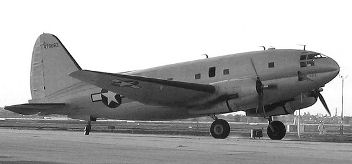
C-46 Commando
In September 1942, ground crews worked around the clock keeping aircraft in good condition as flight crews flew with little rest, while elements of the 32nd Division, with equipment, were flown from the mainland of Australia to New Guinea. This was an all-aerial show and all available transport aircraft were pressed into service.
Early in November 1942, Kokoda fell to the Australians and our aircraft flew over the Owen Stanleys again carrying men, Jeeps, trailers and many other items needed for combat use. The only method of supplying these outposts was by air and the men had little respite in those days. At the same time, a large-scale movement of troops and supplies to the Buna area was initiated. This was the start of the Allied offensive in the South West Pacific Area (SWPA).
Pursuant to Paragraph 2, General Order No. 32, Headquarters Fifth Air Force APO 923, dated 12 November 1942, the 21st Troop Carrier Squadron had been assigned to the newly designated 374th Troop Carrier Group. Colonel Prentiss was the first Group Commander.
Pursuant to Movement Order No. 25, Base Section 3, dated 29 January 1943, the 21st TCS changed station to Jackson Drome, Port Moresby. The Air Echelon left Archerfield Airfield in Brisbane on 18 February 1943 and arrived at Wards Drome, Port Moresby, on the same day.
Airborne troops and supplies were hauled in a successful attempt to stop the Japanese drive on Port Moresby during the latter part of 1942, and the Group then started to carry airborne troops and drop supplies to the Australians in their offensive action in the SWPA. The Group distinguished itself in action which was culminated by the successful capture of the Buna area on the east coast of New Guinea.
After the middle of February 1943, the Squadron flew to Wau, Bulolo, Bena Bena, Goroka, Milne Bay, Goodenough Island, and Woodlark Island in formation. During this period supplies were dropped to infantry patrols operating to the rear of Japanese lines. Daily flights were made to Doboura (possibly Dobodura), where a large base was being constructed.
On 12 April 1943, the Squadron witnessed the largest display of Japanese air power when about 100 Japanese bombers and fighters flew over 14 Mile Airfield and Wards Drome, dropping sticks of bombs on both airfields. Several 21st TCS aircraft were landing at the time, but not a single casualty was sustained.
Troop Movement Directive No. 116, Headquarters, Fifth Air Force, dated 20 September 1943, Headquarters Advance Echelon, Fifth Air Force, dated 30 September 1943, ordered the 21st Troop Carrier Squadron back to Archerfield Airfield in Brisbane. The movement began on 28 September 1943 and was completed on 30 September 1943. 249 officers and enlisted men and individual equipment weighing 82,744 pounds was moved in 15 aircraft loads.
Upon its return to Australia the 21st TCS came under the operational control of the Directorate of Air Transport.
On 3 October 1943, per S.O. 225, Headquarters 21st TCS, dated 3 October 1943, 11 officers and 12 non-commissioned officers of the Royal Netherlands East Indies Air Force Detachment were assigned to the 21st Squadron for duty.
The last three months of 1943 saw performances beyond normal conception - besides maintaining an uninterrupted flow of medical supplies, and equipment to units in Australia – New Guinea area, and carrying high tonnages in ration to the number of aircraft available, leave aircraft were operated between Sydney and Port Moresby and return. Almost daily trips were taken to Port Moresby, Fall River, Lae, Gusep, Finschaven, Doboura (possibly Dobodura), Goodenough Island, Tobriand Islands and Woodlark Island. From time to time test droppings were made at Cairns in far north Queensland.
At Archerfield Airfield, the 21st Troop Carrier Squadron was housed in barracks. Both officers and enlisted men were living under crowded conditions, but later a new Orderly Room and Officer’s Barracks were constructed. The Squadron operated its own mess halls, and a branch Post Exchange in the camp area under the supervision of the Base Section 3 Post Exchange. An Officer’s Club and a Non-commissioned Officer’s Club were conducted within walking distance of the camp area.
Weather took its toll. On 16 November 1943, a 21st Troop Carrier Squadron aircraft was lost at Springsure, in Queensland and on 21 November 1943, another aircraft and crew disappeared in the vicinity of Rockhampton in central Queensland.
Lectures on sex hygiene were given monthly. All enlisted men were required to be cleared through the dispensary before and after leave. Three cases of gonorrhoea had been hospitalised.
A six week’ atabrine regime (1 tablet daily, 6 days a week) was given to the whole command on moving back to Archerfield. Three cases of malaria were hospitalised. Atabrine was made available to air crews flying in malaria areas.
The morale of the men was satisfactory. Movies were shown at least three times a week and there were stage shows once a week. A well-stocked Postal Exchange operated at Archerfield. An Officers’ Club and a Non-commissioned Officers’ Club operated there as well.
On 26 December 1943, the Chaplain paid an official visit to the 21st Troop Carrier Squadron at Archerfield and was able to talk personally with most of the officers and enlisted men. He found that religious services were held at a convenient time and he suggested to the Chaplain of the Fifth Air Force that evening services could be held to enable both the air crew and ground crew to attend. While the Chaplain was absent from Brisbane, Chaplains Kropheski and Cavanaugh, casual officers awaiting assignment, said a mass each on New Years Day and the following Sunday.
The unit strength at the end of March 1944 was as follows:-
Officers, ground crew 10
Officers, flight crew 43
Enlisted Men, ground crew 172
Enlisted men, air crew 50
During March 1944 about 40 paratroopers were trained. They made about 200 jumps.
The Officers’ Club at Archerfield Airfield was reopened on 2 March 1944 after about three weeks of redecoration.
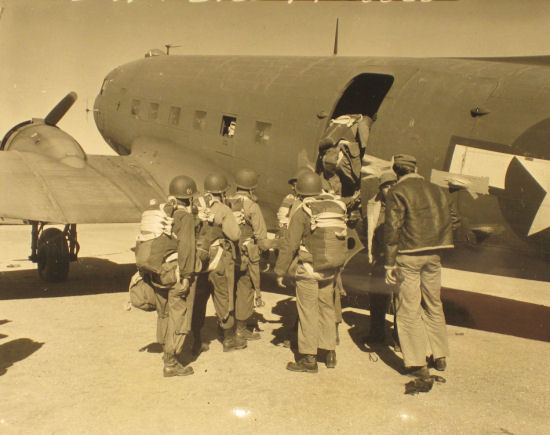
Photo:- NARA SWPA-SC-44-6635
Members of the 462nd Parachute FA
Battalion from Camp Cable, being
loaded on to a C-47 at Archerfield Airfield on 6 May 1944 for their
first practice jump. Most likely a 21st Troop Carrier Squadron Aircraft.
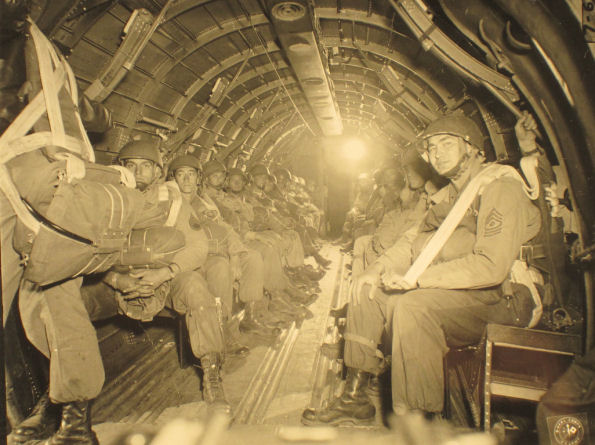
Photo:- NARA SWPA-SC-44-6633
Members of the 462nd Parachute FA Battalion from Camp Cable
During April 1944, the men of the 21st Troop Carrier Squadron participated in several competitive baseball and basketball games with other organisations in Base Section 3 in the Brisbane area.
A Detachment of 25 officers (23 air crew and 2 ground crew) and 13 aircraft were stationed at Nadzab, in New Guinea from 5 May to 16 May 1944 to carryout operational flights in the New Guinea area. A Detachment of 1 officer (ground crew) and 10 enlisted men (ground crew) departed by air for Townsville on 27 May 1944, to maintain Squadron aircraft flying from Townsville. In May 1944 there were 9 C-47s and 17 C-47As assigned to the 21st Troop Carrier Squadron.
On 3 July 1944, Captain Joseph M. Moore was appointed Commanding Officer replacing Major Myron J. Grimes.
July 1944, was marked mainly by Detached Service at Nadzab, The first echelon had arrived at Nadzab on 2 July 1944. Within two days the Squadron was operating 15 aircraft under direct supervision of the 54th Troop Carrier Wing. The Squadron flew freight into Wakde, Owi, Biak and Noemfoor Islands. Return flights to Nadzab were mostly evacuation of sick and wounded. The Engineering Section of the 21st Troop Carrier Squadron sent 24 maintenance personnel and 16 aerial engineers to Nadzab as part of the Detachment in Nadzab.
After 11 months at Archerfield, interrupted by extended periods of detached service by elements of the Squadron in New Guinea, the 21st Troop Carrier Squadron officially moved to Nadzab, in the Markham Valley in New Guinea on 26 August 1944. Approximately 52 plane loads were flown from Archerfield to Strip No. 2 at Nadzab between 25 August 1944 and the end of the month. A water echelon of 11 men under the command of Captain Edward L. Percival left Brisbane to accompany heavy equipment unsuitable for air transport.
Captain Edward L. Percival married Miss Rae Narelle Jones of Milton, NSW and S/Sgt Robert E. Lee married Miss Peter Hinera Kelley of Brisbane during August 1944.
A son, Phil Daniel Lacey, was born to 1st Sergeant Daniel G. Lacey, Jr. and his wife, Gloria Lacey, in Brisbane, a few days before the Squadron left for New Guinea.
Commanding Officers
On 3 April 1942, at the time that Air Transport
Command, at Archerfield Airfield was
redesignated as the 21st Transport Squadron, Major Edgar W. Hampton was the
Commanding Officer. He retained command until 12 October 1942, when Major Fred
M. Adams assumed command. When Major Adams assumed command of the
374th Troop Carrier Group on 23 May 1943,
Captain Philip M. Eckberg assumed command of the 21st TCS. Upon Major Eckberg’s
receipt of orders returning him to the United States, Major Myron J. Grimes
assumed command of the 21 TCS on 23 September 1943.
Some aircraft crashes and forced landings
| DATE | LOCATION | AIRCRAFT | SERIAL NO | DETAILS |
|
Air Transport Command (Archerfield) |
||||
| 4 Feb 1942 | Bathurst Island, NT | Douglas C-53B-DO | #41-20051 | Returning from Java found Darwin closed due to bad weather and turned back to Bathurst Island where it forced landed and damaged port wing and aileron. Later strafed by Japanese Zeros that wrote it off. |
| 26 Feb 1942 | Beach near Cape Londonderry, Vansittart Bay, 400 miles north of Broome | C-53-DO (later called a Skytrooper), VHUGY | #41-20066 | They flew past Broome at night and ran our of fuel. |
|
21st Transport Squadron (Archerfield) |
||||
| 25 May 1942 | North east of Alice Springs, NT | C-39-DO (DC-2-243), VHCCA, "Anne" | #38-505 | Crashed after takeoff. Overloaded by 2,762 pounds. Crew of 4 killed |
| 23 Jun 1942 | Charters Towers | C-32A, (DC-2-115G) , VHCXF | #41-1375 | Swerved off runway during takeoff due to cross wind and struck truck |
|
21st Troop Carrier Squadron (Archerfield) |
||||
| 6 Nov 1942 | 30 miles east of Charleville | DC-5-511, VHCXB "Wakago" | #41-424 but later #44-83231 | Made a forced landing after an engine failure. Hit an anthill at 70mph pushing an undercarriage strut through a wing. No serious injuries. |
| 13 Nov 1942 | Near Loganlea, near Brisbane | DH-82 Tiger Moth | ? | Struck a high voltage transmission line, crew of 2 killed |
|
21st Troop Carrier Squadron (Jackson Field) |
||||
| 8 Apr 1943 | Between Garbutt Airfield and Cooktown Airfield | C-49-DO "Calamity Mary Jane", VHCDF | #41-7694 | Took off from Garbutt Airfield piloted by 1st Lt Leonard N. Guest on a flight via Cooktown Airfield for Port Moresby. This aircraft failed to arrive at either airfield. Crew of five missing in Action. Another source suggests this was a member of the 46th Troop Carrier Squadron. |
| 12 May 1943 | near Oro Bay, New Guinea | ? | Crew of three Missing in Action. S/Sgt Pilot Lorenzo R. Gower, and Cpls. James G. Hickman and Dominic P. Verdi | |
| 15 Aug 1943 | near Tsilli Tsilli, in New Guinea | C-47-DL VHCJB | #41-18431 | Two aircraft were swarmed upon by Japanese Zeros. This aircraft crashed killing its crew consisting of 1st Lts. Enoch P. Burley and James F. Miles, T/Sgt Edward R. Beringer, and Pvt. John Kvaka, Jr. |
| 15 Aug 1943 | near Tsilli Tsilli, in New Guinea | C-47-DL VHCFG | #41-18668 | Two aircraft were swarmed upon by Japanese Zeros. This aircraft was never located. Its crew, consisting of 1st Lt. Charles O. Cathcart, F/O Darwin R. Hamilton, Sgt. Theodore Slocki, and Cpl. William H. Fetzer, plus 3 passengers were listed as “Missing in Action”. |
|
21st Troop Carrier Squadron (Archerfield) |
||||
| 16 Nov 1943 | Rewan Station south of Springsure | C-47-20-DL, VHCGK | #42-23420 | Disintegrated in mid air killing its American crew of four consisting of 1st Lt. Raymond E. Anglin, 2nd Lt. Joseph W. Kennedy, Sgt. Frank J. Ropinski and Sgt. Harold L. Baumstein plus an American Sergeant (passenger) and fourteen Australian soldiers (passengers). |
| 19 Nov 1943 | Cairns Airfield | C-47A | Crashed while landing due to pilot error. It suffered undercarriage damage and was later salvaged (See note below). | |
| 21 Nov 1943 | Monto area, 65 miles west of Bundaberg | C-47-DL, radio call sign VHCGC, "Star Duster", | #41-18648 | 13 were killed including its crew which consisted of 1st Lt. Victor N. Gibson, 2nd Lt. Michael L. Reitman, S/Sgt Everett L. Ahmann, and John F. Giugno. Two other American passengers and seven Australia service personnel were also killed. Located on 22 June 1948 by a stockman. |
| 1 Dec 1943 | Townsville Airfield | C-47A | #43-30752 | C-47A #43-30752 was damaged when its landing gear failed on landing at Garbutt Airfield. This C-47A then hit two other C-47A's that were parked at Garbutt Airfield, namely #42-24227 and #43-30755. C-47A #43-30755 and was later salvaged (See note below). |
| 1 Dec 1943 | Townsville Airfield | C-47A | #42-24227 | C-47A #43-30752 was damaged when its landing gear failed on landing at Garbutt Airfield. This C-47A then hit two other C-47A's that were parked at Garbutt Airfield, namely #42-24227 and #43-30755. C-47A #43-30755 and was later salvaged (See note below). |
| 1 Dec 1943 | Townsville Airfield | C-47A | #43-30755 | C-47A #43-30752 was damaged when its landing gear failed on landing at Garbutt Airfield. This C-47A then hit two other C-47A's that were parked at Garbutt Airfield, namely #42-24227 and #43-30755. C-47A #43-30755 and was later salvaged (See note below). |
NOTE:- In USAAF terminology, "salvaged" means written off/reduced to salvage, i.e. stripped of re-usable parts.
Health
In the early days at Archerfield the
members of the 21st Troop Carrier Squadron were treated in the Headquarters and
Headquarters Squadron, Fifth Air Force, dispensary, which was located at the
other end of Archerfield Airfield. Captain
Young, the Squadron surgeon, later set up a dispensary when the squadron
relocated to Port Moresby.
Upon return to Archerfield in October 1943, the 21st Troop Carrier Squadron maintained its medical section in conjunction with Headquarters and Headquarters Squadron, Fifth Air Force. Captain Arthur V. Simang, Flight Surgeon for the 21st Troop Carrier Squadron and five enlisted men used the equipment and dispensary of Headquarters and Headquarters Squadron, as well as to help operate the dispensary.
The dispensary was well equipped to handle routine cases and also minor emergencies. If the necessity arose, twenty patients could be bedded in two wards, which were not used at that time. Hospital patients were either sent to the 105th General Hospital at Gatton or the 42nd General Hospital at Stuartholme, both located in south east Queensland in or near Brisbane.
In addition to the routine duties, the medical detachment shared with Headquarters and Headquarters Squadron the responsibility of handling the arrival and disposition of air evacuation patients.
The 21st Troop Carrier Squadron was the longest serving USAAF unit at Archerfield Airfield.
REFERENCES
AFHRA Reel No. A0971
"374th Troop Carrier Group 1942-1945" by Col. Edward T. Imparato
Douglas DC-3-194B VH-ANR Oana MSN 1944 (AA000032) - Queensland Air Museum
21st Transport Squadron (21st TS)/21st Troop Carrier Squadron (21st TCS) - Pacific Wrecks
ACKNOWLEDGEMENTS
I'd like to thank Bob Livingstone, Ron Cuskelly and Justin Taylan for their assistance with this web page.
Can anyone help me with more information?
"Australia @ War" WWII Research Products

|
|
© Peter Dunn 2023 |
Please
e-mail me |

This page first produced 3 April 2026
This page last updated 10 April 2026


