
CRASH LANDING OF A DOUGLAS
DC-5-511
ABOUT 30 MILES EAST OF CHARLEVILLE, QLD
NEAR LURNEA SIDING
ON 6 NOVEMBER 1942
IN AUSTRALIA DURING WWII
Douglas DC-5-511, VHCXB "Wakago" of the 21st Troop Carrier Squadron, 374th Troop Carrier Group, USAAF took onboard 20 US Service personnel at Charleville Airfield on their way to Brisbane on leave. At 6,000 feet a newly installed engine stopped. The pilot, Carl William Widt (RAAF 41496), feathered the airscrew but he was unable to maintain height even with the remaining engine flat out. He diverted to an emergency landing strip near Lurnea Siding, about 30 miles east of Charleville. His co-pilot was Lieutenant Barney Cederholm.
Pilot Officer Carl William Widt (RAAF 41496), was able to make a successful landing however he hit an anthill at 70mph, which pushed an undercarriage strut through a wing. The aircraft was severely damaged, but fortunately there were no serious injuries.
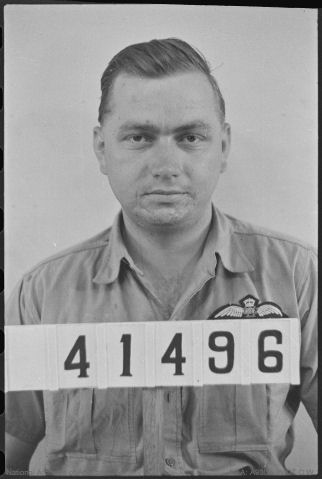
Photo:- NAA Photo
Carl William Widt (RAAF 41496)
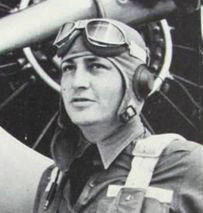
Photo- via Alex Nott
Co-pilot Lieutenant Barney Cederholm
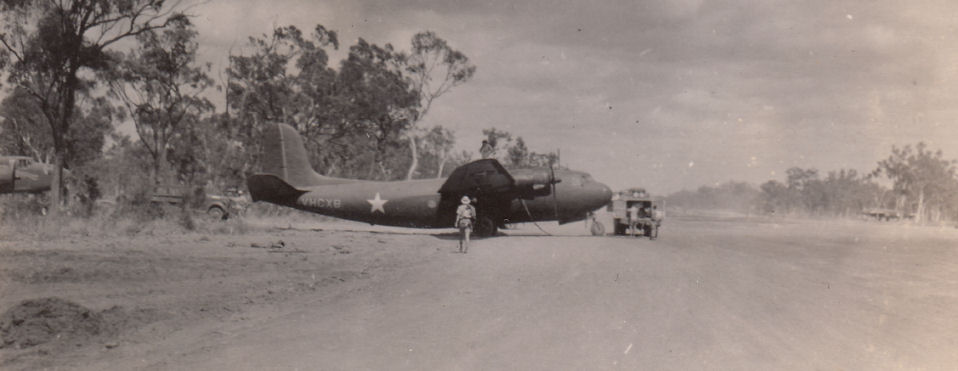
Photo:- ex US HRA via Ed Rogers
DC-5 VHCXB refuelling at Breddan Airfield
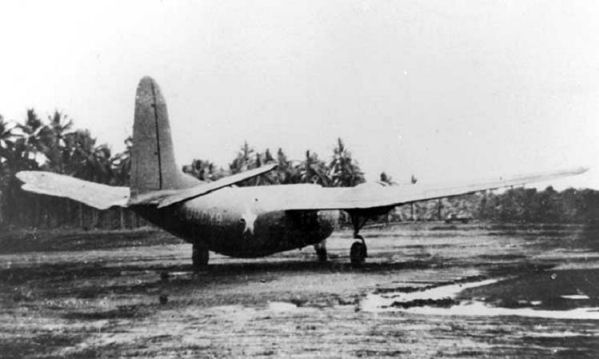
Photo:- Geoff Goodall Collection
VHCXB at Milne Bay, New Guinea 1942
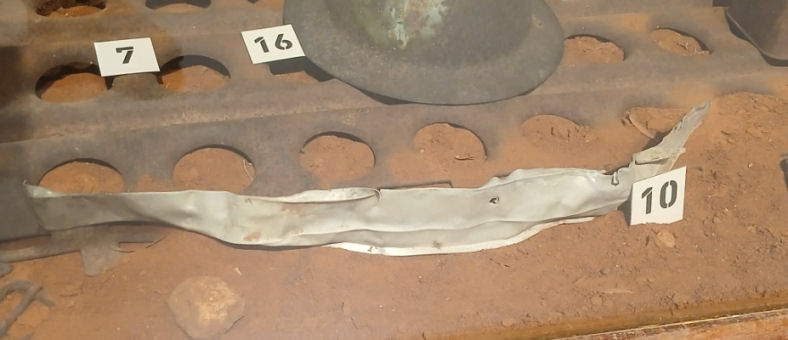
Photo:- Alex Nott
The small strip of aluminium labelled 10 is
believed to be from Douglas DC-5-511, VHCXB
"Wakago". It was found near the crash site by Alex Nott of
WWII Secret Base Charleville
36 Squadron News Bulletin Issue 13 July 1993 includes an interview with "Arch" Widt which describes the lead up to this crash landing:-
"In June 1942, Widt and nine other RAAF pilots were instructed to report to USAAF 22TCS at Essendon. On arrival they were informed that five were to remain with 22TCS and five were to be transferred to 21TCS at Archerfield. Widt went to 21TCS at Brisbane."
"When we joined the 21st T.C.S. in June 1942 it had DC-2’s, DC-5’s, two B-18 Douglas Digby bombers, some older DC-3’s (C-53’s) and only two C-47’s. The pilots flew whatever type happened to be available and swapped regularly from one type to another. Initially the Australians flew as co-pilots but we became DC-3 Captains after only a few months."
"On one flight as Captain I set off from Archerfield for Daly Waters in DC-5 VH-CXB with U.S. Lieut. Barney Cederholm as co-pilot. We refuelled at Charleville and Cloncurry and all was going well until one engine showed increasing oil temperature and decreasing oil pressure. After a further ten minutes the gauge showed no oil pressure at all, so the engine was shut down and its airscrew was feathered. We reached Daly Waters after 1.5 hours on one engine and a satisfactory landing was made. There was quite a delay before a replacement engine could be obtained but after three weeks one was flown to us from Archerfield. When complete, we took off from Daly Waters with the failed engine, tools and other equipment on board. Everything went well during the flight to Cloncurry but when we touched down we found that we had no brakes so we took straight off again. From a four gallon tin of hydraulic oil which was always carried in the cockpit, we topped up the hydraulic system and a satisfactory landing was then made. After staying overnight at Cloncurry the next leg to Charleville was without incident."
"At Charleville, on 6th November 1942, we took on board about 20 U.S. Servicemen who were heading to Brisbane on leave. After climbing to 6000 feet. the “new” engine, without warning, lost power completely. We feathered the airscrew but were unable to maintain height even with the remaining engine flat out. Having noted from our map that there was an emergency landing strip near Lurnea Siding, about 30 miles east of Charleville, we headed for it. A satisfactory touch-down was made but unfortunately, on the strip, there was an anthill which was hit at about 70 m.p.h. causing the undercarriage strut to be pushed through a wing. Substantial damage to the airframe resulted but nobody was injured. . . . . Eventually the crew and passengers were taken back to Charleville by Americans from the Charleville base."
HISTORY OF DC-5-511 VHCXB "WAKAGO"
VHCXB "Wakago" was originally ordered for British Airways as one of nine DC-5s. It was however transferred to KLM Koninklijke Luchvaart Maatschappij in 1939 during its construction. It was initially built as a DC-5-510 fitted with a forward cargo door and seating for 17 passengers. Three other DC-5s were built for KLM as DC-5-511s with seating for 22 passengers. VHCXB was initially to be registered as PH-AXA with the name "Alk" (Razorbill), but these were not adopted. It was registered as PJ-AIW with the name "Wakago" (Wild Goose) with KLM West Indies Division, Curacao on 8 May 1940.
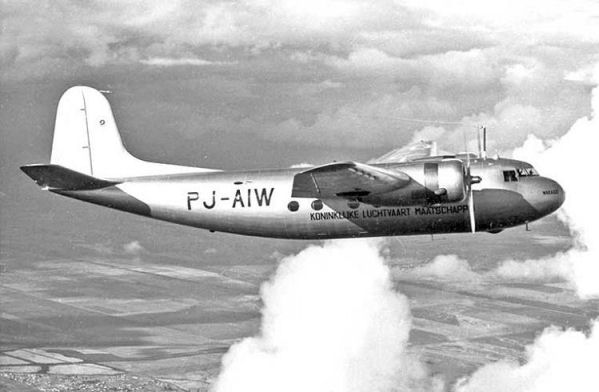
Photo:- Douglas via Harry S. Gann
DC-5 PJ-AIW "Wakago" pre-delivery photo over California.
The Netherlands Government in exile in New York instructed KLM to sell the two West Indies Division DC-5s to the Netherlands East Indies Government for use by the NEI Air Force in 1941. By the time they arrived in NEI, it was decided to lease them to KLM instead. "Wakago" flew to Santa Monica, California, where it was converted to a DC-5-511 with seating for 22 passengers. It was then disassembled and shipped to NEI where it was registered as PK-ADC with KNILM Koninklijke Nederlandsche-Indische Luchvaart Maatschappij, Batavia, NEI on 10 June 1941. It arrived by ship at Tanjung Priok, Java in September 1941 and was assemble by KNILM and entered service with KNILM on 29 September 1941.
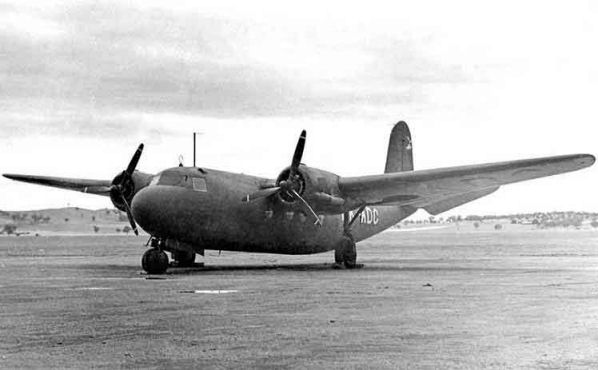
Photo:- John Hopton Collection
DC-5 PK-ADC at RAAF Forest Hill, NSW in 1942
PK-ADC was allocated to NEI-AF with Serial No. D-90 and in December 1941 it was painted in olive drab camouflage with light undersurfaces. On 15 February 1942, KNILM flights to Australia were suspended due to the Japanese invasion of NEI. The KNILM aircraft, four DC-5s and other aircraft were initially hidden at Tjikampek, north of Bandoeng, Java in February 1942.
On 1 March 1942, PK-ADC and 5 other aircraft escaped to Australia carrying refugees. Three of the five aircraft in addition to PK-ADC were:-
KNILM DC-2 PK-AFK (later VHCXG)
KNILM DC-2 PK-AFL (later VHCXH)
KNILM Lockheed 14 PK-AFP (later VHCXJ)
DC-5 PK-ADC was piloted by Captain Dirk Rab who initially decided to refuel at Broome in Western Australia. However due to a number of aircraft waiting for fuel, he decided to fly on to Derby to refuel. He ran out of fuel and made an emergency landing on some dry mud flats outside Derby. They took on enough fuel to fly back to Broome where they refuelled and took off just before the major Japanese air raid on Broome on 3 March 1942. They flew on to Sydney where they cleared customs at Mascot Airport on 4 March 1942.
On 19 March 1942, the Australian Government ordered that KNILM aircraft in Australia were to be transferred to the Australian Government for a nominal 5 Pounds each. They were planned to supplement Australian airlines which had lost most of their aircraft due to RAAF impressments. However General Douglas MacArthur, ordered the Dutch aircraft to be transferred to the USAAF for military transport duties in Australia with Air Transport Command. They were flown by Dutch crews carrying US cargo and personnel within Australia. PK-ADC was struck off KNILM charge on 28 March 1942 and handed over to the USAAF.
On 14 May 1942, PK-ADC was flown under the Sydney Harbour Bridge by KNILM crew Captain Dirk Raab and copilot John Gyzemyter. The Dutch aircrew were protesting the sale of their aircraft to the USAAF. PK-ADC was then formally purchased by the USAAF on 15 May 1942. The Directorate of Air Transport, Allied Air Forces was established on 15 May 1942, to manage military transport aircraft operations in Australia by the RAAF, USAAF and Australian civil airlines flying leased military aircraft (QANTAS, ANA, and Guinea Airways). PK-ADC was allocated temporary USAAF Serial No. 41-424 in May 1942 and it was allocated radio call sign VHCXB on 15 May 1942.
It was allocated to the 21st Troop Carrier Squadron, 374th Troop Carrier Group, USAAF 5th Air Force at Archerfield Airfield on 20 May 1942 and operated a courier service between Brisbane and Port Moresby carrying troops and supplies to New Guinea. Only small cargo items could be carried due to the lack of a cargo door.
Carl William Widt (41496)
Citation for Air Force Cross
From June, 1942, until May, 1943, Flight Lieutenant WIDT was flying with the U.S.A.A.C. (sic USAAF) operating in New Guinea. During this period, he flew over 100 operational sorties over the Owen Stanley Ranges dropping supplies at Kokoda, Buna, and Wau, frequently without fighter cover and within a few miles of the enemy lines. He then joined a R.A.A.F. transport squadron operating in and beyond New Guinea and successfully carried out more than 150 sorties involving over 1,000 hours as captain of Dakotas.
Flight Lieutenant Widt has now completed 2,500 hours of service flying, and throughout his long period of service has consistently revealed exceptional skill, courage and devotion to duty.
REFERENCES
"Douglas DC-5 in Australia" by Geoff Goodall
ACKNOWLEDGEMENTS
I'd like to thank Alex Nott of the WWII Secret Base Charleville for his assistance with this web page.
Can anyone help me with more information on this crash?
"Australia @ War" WWII Research Products

|
|
© Peter Dunn OAM 2020 |
Please
e-mail me |

This page first produced 28 January 2026
This page last updated 04 April 2026


