
3 SERVICE
FLYING TRAINING SCHOOL 3 SFTS RAAF
AMBERLEY AIRFIELD, SE QUEENSLAND
IN AUSTRALIA DURING WWII
On 26 September 1940, Wing Commander Simms visited Amberley Airfield to make preliminary arrangements for the formation of 3 Service Flying Training School 3 SFTS.
No 3 SFTS formed at Amberley on 21 October 1940, as part of the Empire Air Training Scheme, with a strength of 12 officers and 228 airmen under the temporary command of FLTLT James Arthur Adam (260866) of No 3 Recruit Depot. Wing Commander Robert Henry Simms (31), AFC assumed command of the unit on 28 October 1940.
The units aircraft consisted of Wirraways and Ansons which commenced to arrive on 1 November, and on 18 November 1940, thirty six Empire Air Scheme Trainees reported for duty and commenced lectures and physical training. Flying training commenced on 19 November 1940, and the first solo flight was credited to trainee LAC Poulton on 25 November 1940.
Six pilots and one W/T Operator departed by train from Brisbane for Laverton to ferry back six Wirraways allocated to 3 SFTS from No. 1 Aircraft Depot. Flying training was hampered in December 1940 due to heavy rain making the airfield unserviceable. Wirraways and Ansons relocated to Archerfield temporarily to continue flying training. Amberley was serviceable again on 24 December 1940. Some flying training had also been relocated to Maryborough during December 1940.
Whilst carrying out flying training at Archerfield, Wirraway A20-135, pilot Dennett and A20-168, pilot Lee, collided whilst taxying on 31 December 1940.
On 12 February 1941 at 1245 hours, two Wirraways collided on the ground at Amberley Airfield resulting in the deaths of Flying Officer Patrick Adair Black (558), and L.A.C. Raymond Alexander Humphry (406250) in A20-121 and F/Sgt Nigel Watson (1945), and L.A.C. Douglas Porter Scott (406229) in A20-138. Apparently the Wirraway taking off struck the Wirraway taxying back head on. Both aircraft caught fire and were destroyed.
On 4 March 1941 Avro Ansons W1533, LAC Percy Raymund Smith (404265), Navigator LAC Roy McDowall Beattie (404228) and W1535, pilot LAC Eric Arthur Girdler (404052), Navigator LAC John Joseph O’Brien (404258) collided mid air at about 2,500 feet about 11 miles north west of Casino in New South Wales resulting in death of LAC Eric Arthur Girdler (404052). The port main plane of W1533 struck the tail plane of W1535 causing the latter to go into an inverted spin and crash. W1533 was able to fly to Casino Airfield and land safely. LAC Girdler did not have a parachute and LAC O’Brien attempted to parachute with LAC Girdler but they lost their grip on each other and Girdler fell to his death.
At about 1045 hours on 9 April 1941 Wirraway A20-135 piloted by LAC Graham Falconer (404732) crashed at Bundamba Racecourse. Falconer was practicing a forced landing approach and had glided from 2,500 feet to 2,000 feet when he opened the throttle to warm the engine. The engine missed and would not pick up, even though the petrol tank was changed and the wobble pump used. The aircraft put down on the racecourse but overshot the racecourse and hit a fence and nosed over. The pilot was not injured. The port mainplane was broken in half, the centre section port side leading edge was crumpled, the undercarriage was out of alignment, the starboard wing was extensively damaged, two propeller blades were bent, the engine cowls were damaged, the fuselage ribs were bent, the flaps were all damaged, pitot head was damaged beyond repair and the airscrew shaft was .03 out of true.
Also on 9 April 1941, Wirraway A20-160 piloted by pupil LAC F.C. Harper made a crash landing at Amberley. Harper was completing a cockpit drill prior to landing when he noticed warning devices for the undercarriage still working after going through the usual procedure. He flew over Amberley Airfield to attract attention, then came in to land. At the end of the runway, the port undercarriage leg collapsed, causing the aircraft to swing around on its port wing. Subsequent inspection showed that the locking pin had seized. There was no injury to personnel. The port wing tip was buckled, the left hand outer flaps were buckled and ribs broken, and the left hand inner flap was buckled at the extreme end.
On 10 April 1941, Wirraway A20-137 piloted by pupil LAC James Stuart McGregor Ross (404708) crashed at Tyalgum Creek near Murwillumbah in New South Wales. Whilst on a cross-country flight, Ross apparently lost control of the aircraft in cloud and bailed out. He suffered a compound fracture of one leg and shock. The Wirraway was written off. Group Captain Murphy, Squadron Leader Henry Arthur Winneke (250853) and Flight Lieutenant Neale arrived on 12 April 1941, to investigate this crash.
On 14 April 1941, Avro Anson R.3456 piloted by Flying Officer Stewart Carlyle Middlemiss (250492) crash landed at Amberley Airfield. The 2nd pilot on board was LAC M.B. Murphy. The Anson was landed with the undercarriage slightly retracted. The undercarriage collapsed whilst taxying after landing. There was no injury to personnel onboard. The wooden port and starboard airscrew blades broke off. There was damage to the port aileron centre bracket, a section of skin of the port mainplane, the pilot head and the undercarriage gearbox coupling.
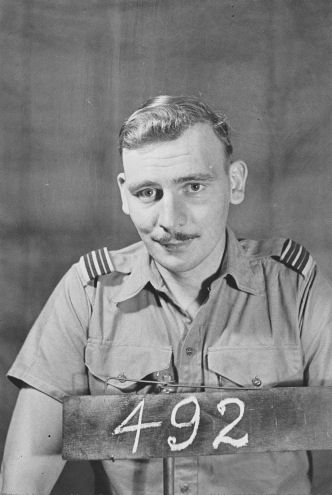
Stewart Carlyle Middlemiss
Wing Commander Leon Victor Lachal (28) took over as Commanding Officer of 3 SFTS from Wing Commander Robert Henry Simms (31) on 14 April 1941.
On 15 April 1941, Wirraway A20-169 crashed at Mutdapilly killing 1st pilot Sgt Peter Blair McLaughlan (407063) and 2nd pilot LAC Reginald Victor Harvey (406246). Whilst engaged in air to ground gunnery practice, the Wirraway dived into the ground. All parts forward of the rear cockpit were severely damaged, including the mainplanes. Group Captain Murphy, Squadron Leader Henry Arthur Winneke (250853) and Flight Lieutenant Neale arrived on 16 April 1941 to investigate this tragic accident.
On 24 April 1941, Wirraway A20-194 piloted by Flight Lieutenant John Beresford Hawdon (265) crashed near Amberley Airfield whilst night flying. The Wirraway turned on to its back at approximately 2,000 feet and dived, striking the ground almost vertically killing the pilot Flight Lieutenant Hawdon. The aircraft was written off. The funeral for F/Lt Hawdon was held on 27 April 1941.
On 15 May 1941, Avro Ansons R3453 piloted by LAC Young and W1948 piloted by LAC Steinback collided on Amberley Airfield. Anson R3453 had a damaged tail wheel unit, and mainplane main spar were broken. The port and starboard undercarriages were damaged, as well as the pilot head, the nose of the aircraft, the headlight, flaps, and the port and starboard engine propellers were slightly bent. Anson 1948 had damage to the leading edge of the port mainplane, pitot head, port and starboard flaps, rear of the gun turret, the upper part of the fuselage tail wheel, ailerons and engine rocker cover.
At about 1145 hours on 15 May 1941, Anson R3532 piloted by LAC Neville Patrick Peter Kearney 403055 collided with Anson R3554 piloted by LAC Godfrey Rees Jones (403054) at Amberley Airfield. Anson R3532 was returning from practicing steep turns while making a circuit of the airfield he collided with Anson R3554. The pilot of R3554 was carrying out a normal circuit and took avoiding action but it was too late. R3532 suffered slight damage to the leading edge of the port mainplane, a hole in the three ply and torn fabric. Anson R3554 suffered extensive damage to the starboard aileron.
On 20 May 1941, Anson W9775 piloted by W/O H.R. Baldwin with 2nd pilot LAC Austin and others under instruction as follows, Sgt. White, LAC Angus, and LAC Anderson, attempted an instructional forced landing on an Emergency Landing Ground ELG one mile north of Rosewood. The port wheel struck a stone or stump. The aircraft became airborne and it was flown back to Amberley where a forced landing was made. The undercarriage collapsed on landing. The undercarriage was extensively damaged, one airscrew was bent, there were holes punched in the plywood of the mainplane and the pilot head was damaged.
A Graduation Parade for Course No. 7 was held on 29 May 1941.
On 17 June 1941, Anson N9902 crashed at Dinmore. The crew comprised:- Sgt. James Edwards (407002), LAC Bernard William Reynolds (404894), and LAC Herbert Edgar Pym (404832). The Anson struck the ground at an angle of 45 degrees whilst travelling at high speed, resulting in the instantaneous deaths of all onboard and the complete write-off of the aircraft. Group Captain Murphy and S/Ldr Henry Arthur Winneke (250853) arrived on 18 May 1941 to investigate the cause of the crash.
A Graduation Parade for Course No. 8 was held on 26 June 1941. This was the first course run by 3 SFTS.
A Graduation Parade for Course No. 9 was held on 24 July 1941.
On 30 July 1941, Avro Anson R3553 crashed at 0130 hours after colliding with trees half a mile south west of Amberley Airfield during night flying, resulting in the deaths of Flying Officer George Campbell Hughes (665) and LAC Hawtney Montague White (416010). The Inspectorate of Air Accidents arrived on 31 July 1941, to investigate the cause of this crash.
A Graduation Parade for Course No. 10 was held on 20 August 1941.
During August 1941, the erection of 13 Bellman Hangars continued and they were nearing completion. Runways had been tarred and completed. Approximately 20 acres at the south east and ten acres at the north east ends were cleared and flattened.
A Graduation Parade for Course No. 11 was held on 21 September 1941.
The 13 Bellman hangars were completed in August 1941.
A Graduation Parade for Course No. 12 was held on 15 October 1941.
A Graduation Parade for Course No. 13 was held on 13 November 1941.
3 SFTS ORB states that on 15 December 1941, personnel of the USAAF were accommodated at 3 SFTS at Amberley. The total strength of USAAF personnel at 31 December 1941 was 988 personnel. Accommodation facilities were provided at 3 Recruit Depot’s airmen’s quarters and tents were erected by the US Army. The 3 SFTS ORB goes on to state:-
“P-40E Aircraft were assembled during the month (December) using 3 SFTS personnel to assist with the assembly. A-24 aircraft were also assembled by US Army Air Corps (sic USAAF)”
Note:- I’m not sure which USAAF personnel these would have been on 15 December. The 8th Materiel Squadron and the Ground Echelon of the 7th Bomb Group did not arrive in Brisbane until 22 December in the Pensacola Convoy. On 21 December 1941, Military Attache Colonel Van S. Merle-Smith sent a message to General Julian Barnes on the Pensacola Convoy that “all arrangements had been completed for unloading and erection of aircraft and reloading of additional cargo for Philippines, and for disembarking and quartering of personnel.”
On 1 January 1942, Colonel Maitland and Captain Gunn USAAF arrived at Amberley at 1655 hours in a Lockheed 14 aircraft.
A Graduation Parade for Course No. 15 was held on 8 January 1942.
On 9 January 1942, USAAF B-18 landed at Amberley Airfield at 1711 hours.
On 11 January 1942, a Beechcraft 222 arrived from Townsville at 1500 hours.
Captain Gunn, and Colonel Caldwell departed for Townsville at 0900 hours in a Beechcraft 222. Beechcraft 222 arrived at Amberley at 1830 hours.
Lt. Kelman arrived from Mascot in P-40 Warhawk #674 at 0925 hours. Captain Sprague in P-40 Warhawk # 662 and Lt. Wagner in P-40 Warhawk # 678 departed for Bankstown – Laverton at 1105 hours.
On 13 January 1942, USAAF B-18 left for Charleville enroute to Darwin at 1025 hours.
On 14 January 1942, Lt. Henry USAAF departed for Charleville enroute Darwin at 0840 hours in B-18 #37-16.
On 20 January 1942, Lt Henry and Lt Price USAAF departed for Darwin via Cloncurry at 0950 hours in a B-18.
On 29 January 1942, Lt. Helton USAAF arrived from Laverton at 1300 hours in a B-24 Liberator. He departed for Townsville at 1545 hours. Captain Gunn USAAF in a B-17 Flying Fortress and Captain Davis USAAF in a B-24 Liberator arrived from Charleville at 1920 hours.
On 4 February 1942, F/Lt Donald Harry Hunter (497) RAAF of 3 Service Flying Training School 3 SFTS crashed a P-40E Kittyhawk #183 at Nerang approximately 40 miles south east from Amberley. F/Lt Hunter was killed in this tragic accident whilst slow running the engine (running in the engine).
On 5 February 1942, 25 P-40E Warhawks departed for Charleville.
On 9 February 1942 (or was it 8 February 1942), Lt. Wilkite, USAAF, crashed his P-40E Warhawk at Harrisville and was not injured. He was flying in bad weather.
There was no flying training at Amberley Airfield from 8 to 11 February due to wet weather.
On 11 February 1942, eleven P-40E Warhawks departed for Mascot Airfield. On 12 February 1942, a further 15 P-40E Warhawks departed for south at 0810 hours and a further 10 P-40Es headed south at 0955 hours but returned due to bad weather.
On 13 February thirteen P-40Es departed for Mascot. Another eleven P-40Es departed for Richmond Airfield at 0915 hours.
On 15 February 1942, fifteen P-40Es departed for Richmond Airfield in New South Wales. Avro Anson W2211 Crashed after takeoff at 1600 hours on 15 February 1942, approximately half a mile north of the Amberley Airfield boundary. LAC James Malcolm Alexander Stirling (408711) was killed in this tragic crash. The engines appeared to fail after takeoff and the aircraft stalled as it attempted to turn back to the airfield.
On 18 February 1942, 16 A-24s departed for Charleville.
Eight P-40E Warhawks arrived from Richmond on 22 February 1942.
By 1 March 1942, there were approximately 1,000 USAAF personnel attached to 3 SFTS.
A Graduation Parade for Course No. 16 was held on 5 March 1942.
On 16 March 1942, Group Captain Lachal was posted from 3 SFTS to Headquarters Amberley as its new Commanding Officer. Wing Commander Wight became the Commanding Officer for 3 SFTS in March 1942. The Advanced training Squadron moved to Kingaroy on 16 March 1942. 39 Ansons departed at intervals from 1330 hours to 1530 hours. Trainees and ground staff departed by rail from Ipswich for Kingaroy at 1945 hours.
Amberley Airfield was unserviceable on 26 and 27 March 1942 due to bad weather.
On 28 March 1942, B-26 #40-2376 flown by Captain Bowman arrived from Laverton. Passengers included:- Group Captain Knox, Mr. E.G. Theodore, and senior US Army officers. The party later departed by car.
On 29 March 1942, Wing Commander Wight arrived at 0945 hours from Kingaroy. Action was taken to return Advanced Training Section (A.T.S.) personnel to Amberley pending transferring 3 SFTS to Point Cook and Mallala. Wing Commander Wight departed for Kingaroy at 1340 hours.
On 31 March 1942, all personnel were engaged in clearing 3 SFTS from Amberley Station prior to the termination of 3 SFTS at Amberley.
During March 1942, portion of the U.S. Army camped at the control station.
A Graduation Parade for Course No. 17, the final course for 3 SFTS was held at Kingaroy Airfield on 30 March 1942.
On 1 April 1942, the personnel of the Advanced Training Section, No. 2 Maintenance Squadron, No. 67 Reserve Squadron and all serviceable Avro Anson aircraft, were returned to Amberley, pending the dissolution of the school. A party of 1 Officer and 27 airmen were left at Kingaroy as a rearguard party.
All Flying Instructors, Instructional Personnel, the members of numbers, 18, 19 and 20 Courses, the remaining courses passing through 3 SFTS, portion of the ground staff, and all members of 66 and 67 Reserve Squadrons were then divided between No. 1 S.F.T.S. at Point Cook and No. 6 S.F.T.S. at Mallala as follows:-
| No. 1 SFTS Point Cook | No. 6 SFTS Mallala | |
| 3 SFTS Officers | 21 | 16 |
| Trainee Pilots | 80 | 80 |
| Airmen | 172 | 150 |
| 66 Reserve Sqn Officers | 20 | 11 |
| 66 Reserve Sqn Airmen | 46 | 47 |
36 Avro Ansons went to 1 SFTS at Pont Cook and 49 Ansons went to 6 SFTS at Mallala. 1 Anson went to 8 SFTS at Bundaberg and 1 Gypsy Moth went to 6 SFTS.
The transfer of personnel and most of the aircraft was complete by 10 April 1942. The balance of the personnel comprising 32 Officers, 683 Airmen and 63 Airwomen, were posted to various units throughout the Commonwealth.
Wing Commander F.J. B. Wight, the Commanding Officer was posted to 8 SFTS at Bundaberg to command that unit.
A party of 102 Airmen was attached to Station Headquarters Amberley from 3 May 1942 to wind up the Unit. All Unit records, both secret and non-secret, of no historical interest and of no value, were destroyed by pulping on 20 May 1942. All record and files required by RAAF Station Headquarters Amberley, or likely to be of use to it were handed over to that Headquarters. All Instructional Equipment and Stores were divided between 1 SFTS and 6 SFTS and General Stores and Equipment between Headquarters, RAAF Station Amberley, 3 Aircraft Depot, Amberley, 3 Stores Depot Brisbane, 8 SFTS Bundaberg, and RAAF Station Maryborough. The finalisation of the winding up of 3 SFTS was still in progress at the end of May 1942.
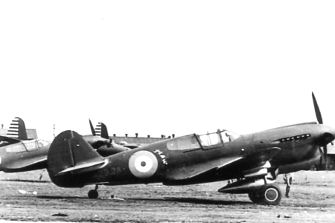
Photo:- C. Bushby via G. Birkett
P40E Warhawk, #41-5336 aka A29-28,
was the "Hangar Queen" left behind at Amberley
P40E Warhawk, #41-5336 aka A29-28, was the Hangar Queen left behind at Amberley, then used for training by 3SFTS RAAF. It was one of the original 18 P-40Es on the Pensacola Convoy that arrived in Brisbane on 22 December 1941. It was later delivered by Sgt West to 75 Squadron at Archerfield Airfield on 25 March 1942.
3 Aircraft Depot was formed at Amberley on 16 March 1942. 106 airmen formerly posted to 3 SFTS as an erection party for the erection of American aircraft, were posted to No. 3 Aircraft Depot and continued with the erection of American aircraft. During March and April 1942, 123 P-39 Airacobras were erected and despatched. 12 B-26 Marauders were also erected.
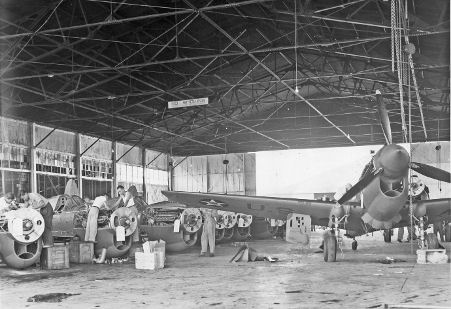
P-40E assembly believed to be at Amberley Airfield
Can anyone help me with more information?
"Australia @ War" WWII Research Products

|
|
© Peter Dunn 2015 |
Please
e-mail me |

This page first produced 13 February 2026
This page last updated 13 February 2026


